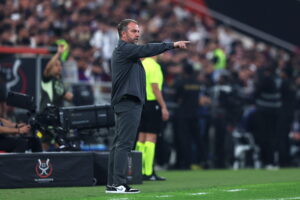
Individual Errors and Missed Opportunities Plague Partenopei in UCL Draw


Copenhagen 1-1 Napoli: Failure to Capitalize on Advantage Proves Costly
Napoli’s Champions League campaign suffered a setback as they were held to a 1-1 draw by Copenhagen at Parken Stadium. While Jens Stage’s first-half red card offered the Partenopei a significant advantage, they failed to convert it into a victory, leaving them with a frustrating single point. This analysis focuses on individual player performances and key moments that defined the match, ultimately highlighting Napoli’s inability to capitalize on their numerical superiority.
Napoli Player Performances: A Mixed Bag
The Napoli squad showcased a range of performances, with some players struggling to find their rhythm while others provided glimpses of brilliance. The team’s overall inability to break down Copenhagen’s resilient defense, even with a man advantage, points to systemic issues and a lack of clinical finishing.
Goalkeeper and Defense
Alex Meret: (Rating: 6.5/10) Meret had a relatively quiet evening, facing limited shots on target. He made a couple of routine saves but was ultimately beaten by Copenhagen’s goal. His distribution was accurate, but he wasn’t severely tested. He couldn’t be faulted for the goal conceded, as it was a well-placed shot from outside the box. Overall, a solid but unremarkable performance.
Giovanni Di Lorenzo: (Rating: 5/10) The captain struggled defensively, particularly in the first half. He was caught out of position on several occasions and failed to provide adequate cover for the central defenders. His attacking contribution was also limited, with few incisive crosses or overlapping runs. Di Lorenzo’s performance was uncharacteristically poor, and he needs to improve his defensive awareness in future matches.
Amir Rrahmani: (Rating: 6/10) Rrahmani was the more solid of the two center-backs, making several important interceptions and clearances. However, he was also partly responsible for allowing Copenhagen’s attackers too much space outside the box, which ultimately led to the equalizing goal. He needs to be more proactive in closing down opponents in those situations.
Kim Min-jae: (Rating: 5.5/10) Kim’s performance was inconsistent. While he displayed his usual aerial dominance and physical presence, he also made a few uncharacteristic errors in possession and struggled to contain Copenhagen’s quick transitions. His passing accuracy was lower than usual, and he needs to regain his composure in crucial moments.
Mathías Olivera: (Rating: 6/10) Olivera provided a decent outlet on the left flank, contributing with some positive runs and crosses. However, his defensive contribution was less impressive, and he was occasionally caught out of position. He needs to improve his defensive positioning and awareness to become a more complete full-back.
Midfield
Stanislav Lobotka: (Rating: 7/10) Lobotka was arguably Napoli’s best midfielder, dictating the tempo of the game and providing crucial interceptions. His passing was accurate and incisive, and he consistently looked to move the ball forward. However, even his efforts couldn’t unlock Copenhagen’s stubborn defense. His performance highlighted his importance to the team’s midfield structure.
Piotr Zieliński: (Rating: 5.5/10) Zieliński’s performance was underwhelming. He struggled to make a significant impact on the game, lacking his usual creativity and drive. His passing was often predictable, and he failed to provide the killer ball needed to unlock Copenhagen’s defense. He was eventually substituted in the second half, reflecting his ineffective performance.
André-Frank Zambo Anguissa: (Rating: 6/10) Anguissa provided energy and physicality in midfield, but his overall contribution was limited. He won several tackles and interceptions but lacked the composure and technical ability to make a real difference in the final third. His passing accuracy needs to improve if he wants to become a more influential player.
Attack
Khvicha Kvaratskhelia: (Rating: 6.5/10) Kvaratskhelia showed flashes of brilliance, with his dribbling skills and ability to beat defenders causing Copenhagen problems. However, he was often isolated and struggled to find space in the crowded penalty area. His finishing was also lacking, and he missed a couple of good opportunities to score. While he showed his potential, he needs to be more consistent and clinical in front of goal.
Victor Osimhen: (Rating: 5/10) Osimhen had a frustrating evening, failing to make a significant impact on the game. He was well-marshaled by Copenhagen’s defense and struggled to find space to run in behind. His finishing was also poor, and he missed a gilt-edged opportunity to put Napoli ahead in the second half. His performance was a far cry from his usual standards, and he needs to rediscover his goal-scoring touch quickly.
Matteo Politano: (Rating: 6/10) Politano provided some width and energy on the right flank, but his impact was limited. He delivered a few decent crosses, but they were often wasted by Napoli’s attackers. His defensive contribution was also minimal, and he was eventually substituted in the second half.
Substitutes
Several substitutions were made in the second half, but none had a decisive impact on the game. Players like Giacomo Raspadori and Giovanni Simeone were brought on to add fresh legs and attacking impetus, but they failed to break down Copenhagen’s stubborn defense. The substitutions highlighted Napoli’s lack of depth and creative options on the bench.
Key Moments and Tactical Analysis
The match turned on several key moments. Jens Stage’s red card in the first half gave Napoli a significant advantage, but they failed to capitalize on it. Their inability to break down Copenhagen’s organized defense, even with a man advantage, was a major disappointment. Napoli’s lack of creativity in midfield and clinical finishing in attack were also significant factors in their failure to secure a victory.
Copenhagen’s tactical approach was effective in frustrating Napoli. They defended deep and in numbers, making it difficult for Napoli to find space in the final third. Their counter-attacks were also dangerous, and they managed to score a well-deserved equalizer. Their resilience and determination were commendable, and they deserved to earn a point from the match.
Missed Opportunities and Individual Errors
Napoli’s failure to win can be attributed to a combination of missed opportunities and individual errors. Osimhen’s missed chance in the second half was a particularly costly one, and Di Lorenzo’s defensive lapses contributed to Copenhagen’s attacking threat. These individual errors highlighted a lack of concentration and composure in crucial moments.
Looking Ahead
This draw is a setback for Napoli’s Champions League ambitions. They need to learn from their mistakes and improve their performance in future matches. Their inability to break down stubborn defenses and capitalize on numerical advantages is a major concern that needs to be addressed. They need to rediscover their attacking fluidity and clinical finishing if they want to progress further in the competition.
Conclusion
The 1-1 draw against Copenhagen was a frustrating result for Napoli. While they had a man advantage for much of the game, they failed to convert it into a victory. Individual errors, missed opportunities, and Copenhagen’s resilient defense all contributed to their downfall. Napoli needs to improve their performance significantly if they want to achieve their Champions League ambitions.
FAQ Section
What was the biggest factor in Napoli’s draw against Copenhagen?
Napoli’s inability to capitalize on their numerical advantage after Jens Stage’s red card was the biggest factor. They failed to break down Copenhagen’s organized defense and lacked the clinical finishing needed to secure a victory.
How did Victor Osimhen perform in the match?
Victor Osimhen had a disappointing performance. He was well-marshaled by Copenhagen’s defense, struggled to find space, and missed a crucial opportunity to score in the second half.
Was Khvicha Kvaratskhelia effective in the game?
Khvicha Kvaratskhelia showed flashes of brilliance but lacked consistency. He caused Copenhagen problems with his dribbling skills but struggled to find space in the penalty area and missed some scoring opportunities.
What were some of the key individual errors that cost Napoli the win?
Di Lorenzo’s defensive lapses and Osimhen’s missed chance were key individual errors that contributed to Napoli’s failure to secure a victory.
How did Copenhagen’s tactical approach impact the game?
Copenhagen’s defensive approach, defending deep and in numbers, effectively frustrated Napoli. Their organized defense and dangerous counter-attacks made it difficult for Napoli to create clear-cut scoring opportunities.
What areas do Napoli need to improve in to succeed in the Champions League?
Napoli needs to improve their ability to break down stubborn defenses, capitalize on numerical advantages, and rediscover their attacking fluidity and clinical finishing.
Who was Napoli’s best player in the match against Copenhagen?
Stanislav Lobotka was arguably Napoli’s best player, dictating the tempo of the game and providing crucial interceptions. However, even his efforts couldn’t unlock Copenhagen’s stubborn defense.
What does this draw mean for Napoli’s Champions League ambitions?
This draw is a setback for Napoli’s Champions League ambitions. They need to learn from their mistakes and improve their performance in future matches to progress further in the competition.